Dark Mode Light Mode

Keep Up to Date with the Most Important News

By pressing the Subscribe button, you confirm that you have read and are agreeing to our Privacy Policy and Terms of Use
Follow Us
Follow Us
Follow us Follow us

Keep Up to Date with the Most Important News

By pressing the Subscribe button, you confirm that you have read and are agreeing to our Privacy Policy and Terms of Use

Soaking in Tuscany’s Ancient Thermal Spa Country

South of Siena, a cluster of volcano-fed thermal spa towns has drawn bathers since the Etruscans. Here’s where to soak for free, where to book a proper spa stay, and what a 2022 archaeological find means for the region’s oldest sanctuary.
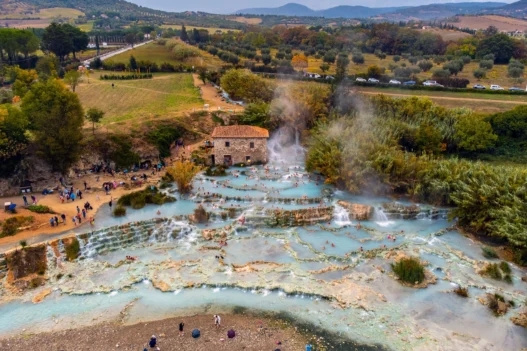
Thermal Spa Tuscany Thermal Spa Tuscany

South of Siena, where the cypress-lined ridges of the Val d’Orcia give way to the wooded slopes of Monte Amiata, Tuscany keeps one of Italy’s least advertised assets: a working thermal spa tradition older than the Renaissance towns visitors come here to photograph. Sulphurous water rises from a dormant volcano and has drawn bathers since the Etruscans, who treated the springs as sacred ground long before Rome built bathhouses over them. Today the same aquifer feeds a scattered network of free cascades, a Renaissance piazza built around a bathing pool, and a handful of serious spa hotels, all within roughly two hours of Florence or Rome by car.

This guide covers the thermal spa country stretched between San Casciano dei Bagni, Bagno Vignoni, and Saturnia, a region built for slow travel by car rather than a single walkable center. Seekers after a genuine bathing ritual will find both free public pools and destination spa hotels here, with enough variation in price and formality to build a multi-day itinerary rather than a single stop. Discerning travelers who want cultural depth without wellness-industry gloss get Etruscan and Renaissance history folded into the same afternoon as the soak, including a 2022 archaeological find that reshaped what’s known about the region’s oldest sanctuary, and that continues to shape the story of San Casciano dei Bagni today.

At a Glance

  • Best season: Late September through May, when the steam rising off the water reads most dramatically against cool air and the region’s summer heat and day-trip crowds have thinned.
  • How to arrive: Fly into Florence or Rome Fiumicino, then rent a car. There is no meaningful train or bus network connecting these towns.
  • How long to stay: Three to four nights to cover the free cascades and at least one spa hotel without rushing between towns.
  • Who it’s for: Travelers who want a bathing ritual with real history behind it, not a single-resort spa week.
  • Don’t expect: A walkable circuit, English-language menus everywhere, or a swim in Bagno Vignoni’s piazza pool. Full-immersion bathing there has been prohibited since a 2010 local ordinance.

Why Tuscany

Tuscany’s thermal reputation predates its vineyards and hill towns by millennia. Monte Amiata, a dormant volcano that last erupted roughly 231,000 years ago, sits at the center of a mineral-rich aquifer that surfaces across the surrounding valleys as hot springs. The Etruscans, who controlled this part of central Italy before Rome’s expansion, treated the mountain and its waters as sacred, and later built the sanctuary structures that Roman engineers would extend into full bathing complexes. At Bagni San Filippo, archaeologists have recovered Roman-era tombs and coins spanning the reigns of Domitian, Trajan, and Constantine, evidence of continuous use across centuries rather than a single settlement. San Casciano dei Bagni carries a similar arc: known since antiquity for its unusually high concentration of springs, its waters have been credited, rightly or not, with everything from digestive relief to fertility since long before the idea of a destination spa existed.

Advertisement

By the Renaissance, Bagno Vignoni’s central bathing piazza was drawing figures like Pope Pius II, Lorenzo de’ Medici, and Saint Catherine of Siena, who is said to have used the waters for her ailing mother. San Casciano dei Bagni’s own thermal culture, known since antiquity, peaked again in the seventeenth and eighteenth centuries under Medici patronage. Then, in November 2022, excavations at San Casciano’s Bagno Grande turned up twenty-four bronze statues of Etruscan and Roman deities alongside thousands of votive coins and inscriptions, a sanctuary complex used from roughly the third century BCE into the fourth century CE. It is now considered the largest deposit of bronze statuary from that era ever found in Italy, and a museum for the finds is planned in the town’s Palazzo dell’Arcipretura.

The Land

The thermal belt sits at the seam between two distinct Tuscan landscapes. To the north and east lies the Val d’Orcia, a UNESCO World Heritage cultural landscape of chalky ridges, cypress avenues, and fortified hill towns like Pienza and Montalcino. To the south and west, the terrain softens into the Maremma, historically wilder and less manicured, with the springs at Saturnia and San Casciano set among oak woods and open farmland rather than postcard vineyard rows. San Casciano dei Bagni, Bagno Vignoni, and Saturnia sit at each point of a loose triangle, each a short, scenic drive from the next, with Monte Amiata’s wooded bulk visible from all three on a clear day.

Monte Amiata itself, at 1,738 meters, is the highest point in southern Tuscany and the reason the water below it runs hot: its dormant magma chamber, formed roughly 305,000 to 231,000 years ago, still heats the groundwater that resurfaces miles away as the region’s springs. The mountain is chestnut-forested rather than bare, popular with hikers in warmer months and home to a modest ski area in winter, and it functions as a quiet counterpoint to the valley towns below, a place to get above the thermal circuit rather than into it.

What to Do

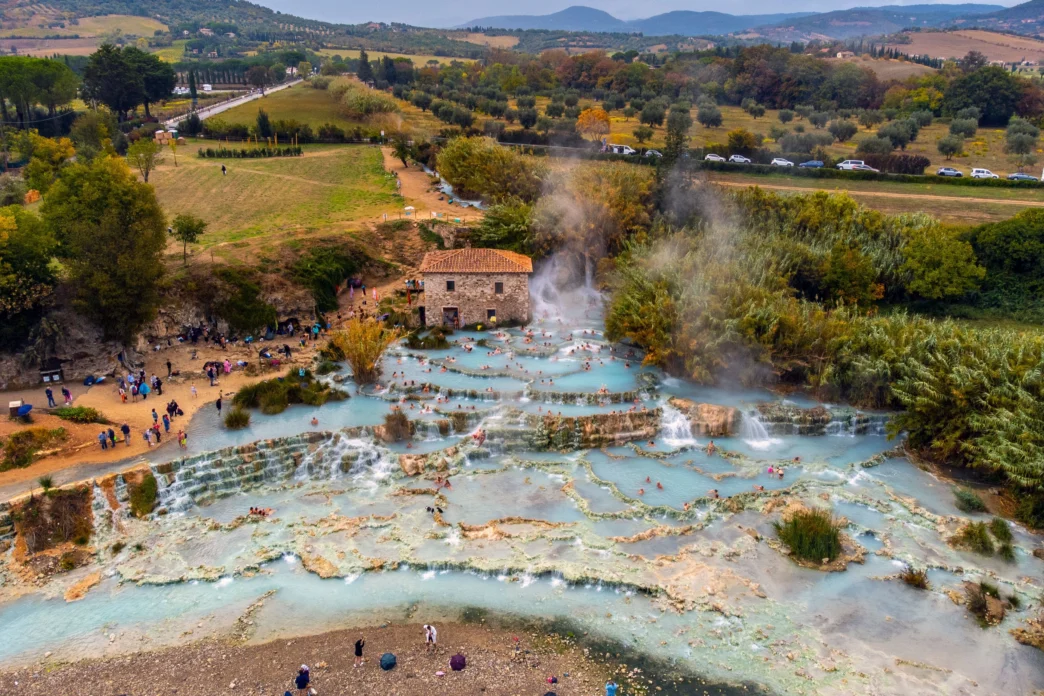
Cascate del Mulino, Saturnia. The region’s best-known free thermal site: a series of travertine terraces and pools formed by centuries of mineral deposit, fed by water that surfaces at around 37.5°C year-round. Access is unrestricted and free, which means the midday and weekend crowds can be significant; an early morning or off-season visit is the more editorial choice.

Fosso Bianco and the Balena Bianca, Bagni San Filippo. A quieter, forested alternative inside the Monte Amiata Nature Park. The water emerges near-boiling at its source and cools as it descends through a series of pools, passing a striking white limestone formation known locally as the Balena Bianca, or White Whale. It’s a five to fifteen minute walk from the parking area, which charges a modest hourly fee in season.

Piazza delle Sorgenti and Parco dei Mulini, Bagno Vignoni. The village’s medieval and Renaissance center is built around a rectangular bathing basin roughly the size of a piazza, fed by water that surfaces near 52°C. Full-immersion swimming here, and in the lower pools of the adjacent Parco dei Mulini, has been prohibited since a 2010 municipal ordinance, with fines for anyone caught bathing. What remains open is foot-soaking in the shallow channels that carry the thermal water through the park below the village, along with the visual spectacle of the steaming piazza itself.

San Casciano dei Bagni’s spa quarter. Beyond its role as a resort town, San Casciano is now a live archaeological site. The Bagno Grande excavation that produced the 2022 bronze find is ongoing, with a dedicated museum and a planned thermal archaeological park still in development; travelers with a specific interest should check locally for current visiting access before planning around it, as the dig is a working site rather than a finished attraction.

Monte Amiata. For a change of register from bathing, the dormant volcano above the valley offers marked hiking trails through chestnut forest, with the springs’ source visible in the landscape’s logic even when it isn’t visible underfoot. It’s a half-day detour rather than a headline stop, best paired with a hotel stay on either side of it.

Where to Stay

Fonteverde (San Casciano dei Bagni). Built around a Renaissance portico commissioned by Grand Duke Ferdinando I de’ Medici in 1607, Fonteverde draws its water from the same 42°C spring system as the town below it. The wellness center spans roughly 5,000 square meters and includes seven thermal pools with waterfalls and whirlpools, an Etruscan-themed path, and views over the Val di Chiana. Treatments lean on the mineral water itself rather than imported spa concepts, which keeps the experience tied to the place. Ultra-luxury tier, and the closest of the four properties to the Bronzes excavation. Book at Fonteverde

Terme di Saturnia Natural Spa & Golf Resort (Saturnia). Set across 120 hectares adjacent to, but separate from, the free public cascades, this resort draws on the same 37.5°C spring via five outdoor thermal pools, an 18-hole golf course, and a 20,000-square-meter spa with a Roman bath, sauna, and Turkish bath. Guests get unlimited access to the pools and hydromassage circuits for the length of their stay, and the property runs its own clinical wing for guests who want bloodwork or diagnostics alongside the wellness program. Premium to ultra-luxury tier, and the most complete resort infrastructure of the group. Book at Terme di Saturnia

Adler Spa Resort Thermae (Bagno Vignoni / San Quirico d’Orcia). Water piped from Bagno Vignoni’s own spring, cooled from roughly 50°C to a swimmable 36°C across its indoor and outdoor pools, with five distinct sauna experiences including a salt grotto and an Etruscan steam room. The resort structures its rate around an all-inclusive model, bundling pool and sauna access, a daily wellness class, and guided walking or biking excursions into the stay rather than pricing them separately. It’s the most programmed of the four properties, useful for travelers who want structure rather than a self-directed spa week. Premium tier. Book at Adler Spa Resort Thermae

B&B Villa Clodia (Saturnia). A small independent guesthouse a short drive from the free cascades, with a garden of wisteria and roses framing a pool carved into travertine, and rooms overlooking either the valley or the flower garden. Each room is individually decorated rather than built to a chain template, and the property leans on personal service over programming. No thermal water piped in, but the most accessible price tier of the group for travelers who want to base themselves near Saturnia without a resort budget. Book at B&B Villa Clodia

Where to Eat

Ristorante Daniela (San Casciano dei Bagni), set in the former stables of the town’s castle facing the main square, serves Tuscan staples like pici all’aglione and pappardelle al cinghiale from a well-stocked cellar list, with outdoor seating that stays open into the evening in warmer months.

La Taverna del Barbarossa (San Quirico d’Orcia) occupies a restored thirteenth-century building on the spot where Emperor Frederick Barbarossa is said to have met papal envoys in 1154. The kitchen runs traditional Val d’Orcia dishes, including bistecca fiorentina, alongside a full gluten-free menu.

I Due Cippi (Saturnia), operating on the town’s main piazza since the 1970s, has built a national reputation around Chianina and Wagyu beef grilled over an open fire, and placed among the World’s 101 Best Steak Restaurants in 2025. It’s a meat-forward, unpretentious room, better suited to a hearty dinner after a day of bathing than a quiet lunch.

Practical Notes

A rental car is close to essential; public transit between the three towns is unreliable at best, and taxis are not something to rely on outside the larger towns. Free thermal sites have no changing rooms or facilities beyond basic parking, so plan to arrive already dressed for the water and bring your own towel and water shoes, since travertine can be slick and uneven underfoot. Bagni San Filippo’s parking area charges a modest hourly fee in season; Cascate del Mulino and Bagno Vignoni’s viewing areas are free. Water temperature at every site stays fairly constant year-round, since it’s spring-fed rather than weather-dependent, so the deciding factor for a visit is air temperature and crowd size rather than season in the strict sense. Sulphur is part of the experience at every site, and it tends to linger on swimwear afterward. And a reminder worth repeating: the piazza pool at Bagno Vignoni is for looking, not swimming.

Frequently Asked Questions

Is Saturnia’s thermal water free to visit? Yes. The Cascate del Mulino falls are open access and free at any hour, which is precisely why they draw crowds. The private pools inside Terme di Saturnia’s resort grounds are a separate, bookable facility with a day-spa option for non-guests.

Can you swim in Bagno Vignoni’s piazza pool? No. Full-immersion bathing in the piazza and in the lower pools of the Parco dei Mulini has been prohibited since a 2010 municipal ordinance, with fines for violations. Foot-soaking in the park’s shallow channels is permitted.

Does the water temperature change with the seasons? Not meaningfully. These are spring-fed sources with fairly stable year-round temperatures; what changes with the season is the air temperature around them and how many other people have the same idea. A winter visit, water steaming against cold air, is arguably the more dramatic version of the same experience.

Inland Tuscany’s thermal towns rarely get the attention paid to its coast or its islands, where the tradition runs just as deep; our look inside Ischia’s thermal spa tradition covers the same volcanic logic playing out in the Bay of Naples. But the springs around Monte Amiata offer something the islands don’t: free public access, a working archaeological dig, and a spa culture that has run, with interruptions, since before Rome existed. Plan for a car, a flexible itinerary, and at least one morning spent doing nothing but watching steam rise off water that has been doing the same thing for a very long time.

Keep Up to Date with the Most Important News

By pressing the Subscribe button, you confirm that you have read and are agreeing to our Privacy Policy and Terms of Use
Previous Post
Wellness retreat Ohio

Wellness Retreats Across Ohio's Forests and Farms

Next Post
Iceland thermal spa

Iceland's Thermal Spas Beyond the Blue Lagoon

Advertisement