


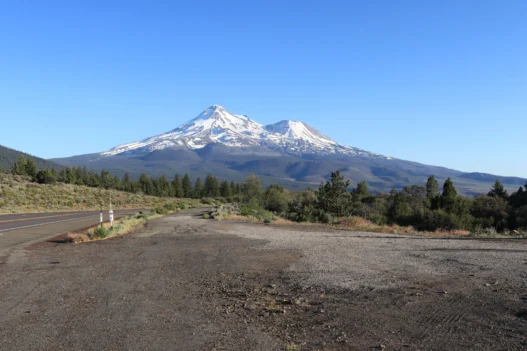
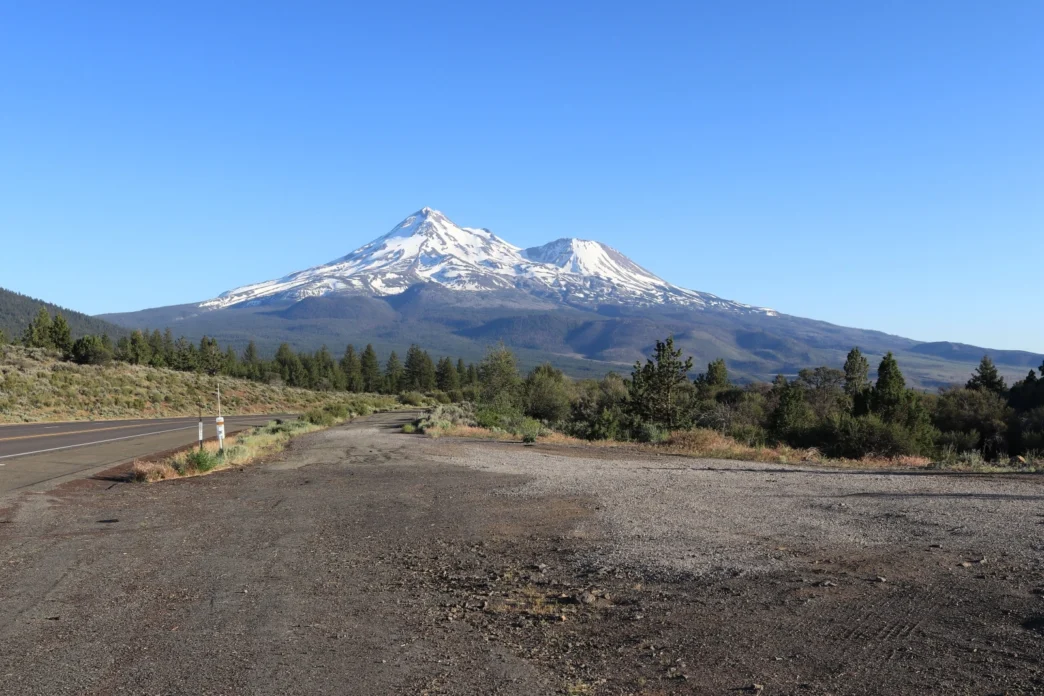
At 14,179 feet, Mount Shasta is visible from more than a hundred miles away on a clear day, a single glaciated cone rising alone above the northern end of California’s Central Valley with no neighboring peak to share the horizon. That isolation is part of why a Mount Shasta spiritual retreat has become its own small industry: no other mountain in the Cascade Range sits this exposed, this abrupt, or this easy to mistake for a message. The town of Mount Shasta City, population under four thousand, sits at the mountain’s base at 3,600 feet, its single main street lined with crystal shops, trailhead outfitters, and diners that have not changed their menus since the 1970s. Climbers, hikers, and seekers headed for a multi-day retreat all pass through the same few blocks before splitting off toward the mountain, the lake, or a retreat center’s front gate.
The mountain carries two distinct histories that rarely overlap in conversation: a documented Native American presence stretching back millennia, and a century-old New Age mythology built on a lost continent called Lemuria. This guide keeps the two separate, then covers the practical layer underneath both, Panther Meadows, the metaphysical shops of downtown, the verified retreat centers currently taking bookings, and where to eat after a day at altitude.
At a glance: 
- Best season: Late June through September, when Panther Meadows has thawed and the high trails are snow-free; late July into early August brings peak wildflower bloom.
- How to arrive: Redding Municipal Airport (RDD) is the nearest airport, about 68 miles and just over an hour’s drive north on Interstate 5.
- How long to stay: Two to three nights, enough for a full day in town, a hike to Panther Meadows, and one evening session at a retreat center.
- Who it’s for: Skeptical travelers curious about the town’s reputation, and seekers enrolling in an actual multi-day retreat program.
- Don’t expect: consensus. Native tribal significance and New Age Lemuria lore are separate traditions with different sources, and the town does not reconcile them for visitors. Nightlife is also not the draw here.
- Where to Stay: Hestia Magic for structured retreat programs from three nights to a month, Mount Shasta Resort for forest chalets and a day spa at the premium end, Inn at Mount Shasta for an accessible boutique in town, and Strawberry Valley Inn at the most accessible price point.
Why Mount Shasta
Mount Shasta sits within the traditional territories of the Wintu, Shasta, Karuk, Achumawi, and Modoc peoples, whose presence in the region predates any recorded eruption of the volcano itself. That long, continuous relationship to the mountain is a separate matter from the mountain’s more recent reputation, which dates specifically to 1905, when Frederick Spencer Oliver published a novel called A Dweller on Two Planets, describing a hidden city called Telos beneath the peak, populated by refugees from the lost continent of Lemuria. The idea gained a second wind in 1931 when Harvey Spencer Lewis, writing as Wishar Cerve, published a nonfiction-styled account of the same Lemurian city, and again in 1987, when the Harmonic Convergence, a globally coordinated New Age gathering, named Mount Shasta one of its power points. More than a hundred New Age organizations now maintain some connection to the mountain, drawn by a reputation that has by now outgrown any single source text. None of this mythology originates with the Wintu, Shasta, Karuk, or neighboring tribes; it developed independently, decades later, among settlers and visitors, and the two traditions are best understood as parallel rather than connected.
The result is a town that takes both histories seriously without merging them. It is a different kind of energy-destination case than Sedona’s red-rock vortex tourism, built less on a marketed circuit of named sites and more on the sheer physical fact of the volcano itself, a landform large and isolated enough that a hundred years of mythology has attached to it without ever needing much infrastructure to sustain it.
The Land
Mount Shasta is a dormant stratovolcano at the southern end of the Cascade Range, the second-highest peak in the Cascades and the most voluminous stratovolcano in the entire Cascade volcanic arc. Mount Shasta City sits directly at its western base, a compact grid of streets running perpendicular to Interstate 5, walkable in full within twenty minutes. The town of Weed sits ten miles north, McCloud fifteen miles southeast, and Dunsmuir a similar distance south along the same interstate corridor, each with its own character but sharing the mountain as a backdrop; McCloud leans toward waterfalls and a slower, more residential pace, while Dunsmuir is built around the Sacramento River and a stretch of railroad history visible in its downtown architecture. Lake Siskiyou, a reservoir just over two miles from downtown, sits at the mountain’s southwestern foot. Above town, a single road climbs toward Panther Meadows and the Bunny Flat trailhead, the practical starting point for both day hikes and technical summit attempts; almost everything above that road requires hiking in on foot.
What to Do
Panther Meadows. An alpine meadow at roughly 7,500 feet, fed by year-round spring water and considered sacred ground by regional tribes for centuries. The meadow is only accessible after the snow clears, typically starting around June 1, with wildflowers peaking in late July and early August. The Bunny Flat to Panther Meadow trail runs about seven miles round trip, a way to take in the mountain’s upper elevations without a technical climb to the summit.
Soul Connections. Downtown Mount Shasta’s largest metaphysical shop, on North Mount Shasta Boulevard, carrying crystals, sound healing instruments, and books, and hosting periodic workshops. It functions as the town’s informal community bulletin board for the wider retreat and healing scene as much as a retail stop.
Mount Shasta Sisson Museum. A small, free museum on the grounds of the Mount Shasta Fish Hatchery, covering the area’s natural and cultural history. Open Thursday through Monday, 10am to 4pm, from late March through December, weather permitting.
Lake Siskiyou. A reservoir at the mountain’s base with a sand beach and no motorized boats permitted, making it a quiet option for kayaking or stand-up paddleboarding with the mountain filling the view. Rentals run through Lake Siskiyou Camp Resort seasonally, from mid-May through Labor Day.
Where to Stay
Hestia Magic
Ten acres of pine, oak, and cedar forest along a year-round creek, run as a dedicated retreat sanctuary since 2014 by stewards Belinda Liu and Peter Cooper. Programming ranges from a three-night digital detox weekend, where phones are stored on arrival, to a seven-night sabbatical with guided land walks and personalized sessions, to monthlong nature immersions between October and March. This is the property for readers actually seeking a structured Mount Shasta spiritual retreat rather than a hotel stay with mountain views, and pricing reflects that: mid-range to premium for the category, with the weeklong sabbatical priced above the digital detox weekend. The property also hosts fixed-date group events tied to the seasons, including a Fall Equinox sabbatical, alongside its year-round, book-anytime formats.
Mount Shasta Resort
Private forest chalets spread across 126 acres at the base of the mountain, each with its own kitchen, living room, and gas fireplace, built around an 18-hole golf course rather than a spa program, though the on-site Sacred Mountain Spa day spa is open to guests after a round of golf or a day on the trails. The Highland House Restaurant serves California cuisine with direct views of the peak. This sits at the premium end of the market here, the closest thing the area has to a full-service resort, and one of the few properties in the area built around a golf course rather than a wellness program specifically.
Inn at Mount Shasta
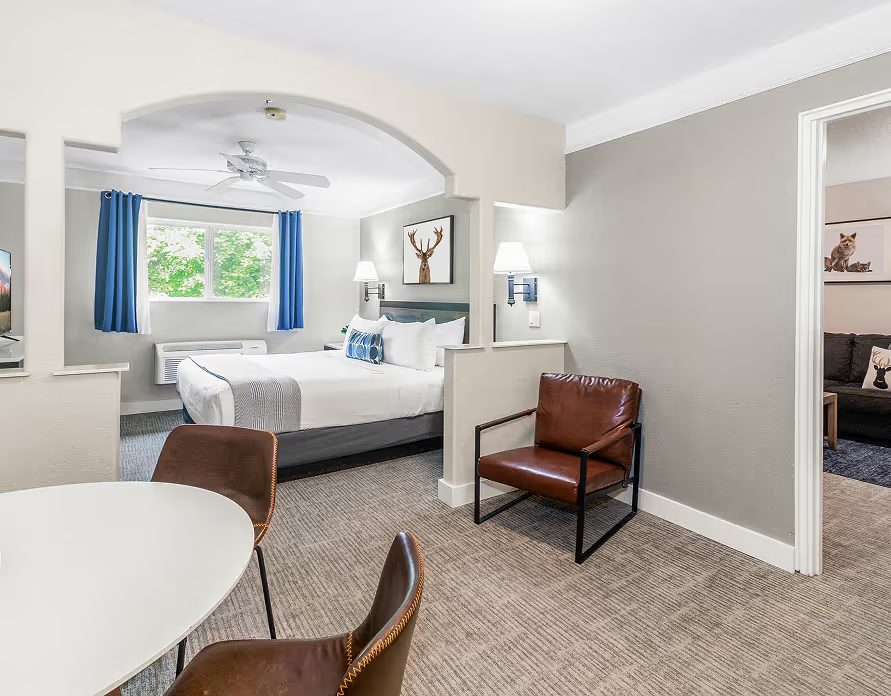
A boutique, dog-friendly hotel steps from downtown, recently rebuilt with a 24/7 staffed front desk, digital door access, and a fire pit where guests gather in the evening. Rooms run from a compact king room to a family suite sleeping six, and the property’s own materials point guests toward what they call the mountain’s “spirit and stillness,” sacred meadows and old springs, without overselling the metaphysical angle. This is the accessible-boutique option on this list, priced below the resort and below a dedicated retreat stay.
Strawberry Valley Inn
A family-run motor inn on South Mount Shasta Boulevard, close enough to downtown to walk in for dinner, with gardens and a dog-friendly policy that draws repeat visitors doing multi-day loops through the region. It is a simpler stay than the resort or the boutique inn, without pretense toward either wellness programming or golf-resort polish, and sits at the most accessible end of this list’s price range.
Where to Eat
Mount Shasta Craft House. Built around beef and pork raised on the owners’ family ranch, the Rafter J in nearby Weed, founded in 1962. The menu leans wood-fired pizza, burgers, and steaks, with a full bar of craft cocktails and local beer, and a casual, unpretentious room that fills up on weekend evenings.
Yaks Mount Shasta Koffee & Eatery. A downtown cafe on North Mount Shasta Boulevard serving baked goods, soups, sandwiches, and smoothies, a practical stop before or after a morning on the trails rather than a destination meal in itself.
Practical Notes
Redding Municipal Airport is the nearest with commercial service, roughly an hour north on Interstate 5; Sacramento International, over three hours south, is the fallback for wider flight options. Rental cars are effectively required, since the town’s attractions and trailheads are spread across several miles and public transit in Siskiyou County is limited. The road above Bunny Flat closes with the first heavy snowfall most years and does not reliably reopen until early summer, so anyone planning a Panther Meadows hike outside July and August should check conditions with the Shasta-Trinity National Forest office directly before driving up. Altitude is a real factor even for visitors staying in town at 3,600 feet; the jump to Panther Meadows at 7,500 feet is enough to affect some hikers, and pacing the first day accordingly is worth it. Lodging here sits mid-range for the category overall, with the resort and dedicated retreat stays at the higher end and the motor inns in town at the lower end.
How many days do you need in Mount Shasta?
Two to three days covers the town itself, a hike to Panther Meadows, and time at Lake Siskiyou or the Sisson Museum. A structured Mount Shasta spiritual retreat, at a center like Hestia Magic, typically runs three to seven nights on its own, separate from any additional time spent exploring the town before or after. Travelers combining both should plan on five to ten days total, with a rest day built in between the retreat portion and any high-altitude hiking, since both are physically demanding in different ways.
Is Mount Shasta worth visiting if you’re not into New Age spirituality?
Yes. The hiking, the volcano itself, Lake Siskiyou, and the small-town main street function independently of the metaphysical reputation, and plenty of visitors come strictly for the outdoor recreation. The crystal shops and retreat centers are easy to skip entirely if they are not of interest, and nothing about the town requires a visitor to engage with either the Lemuria mythology or the Native tribal history to enjoy a weekend of hiking, lake time, and a good meal downtown.
Can you visit Panther Meadows without a permit?
Day hiking to Panther Meadows itself does not require a summit permit, which is only necessary above 10,000 feet for climbers continuing toward the peak. Standard Shasta-Trinity National Forest rules still apply, including seasonal road closures and, during high fire-risk periods, restrictions on open flame.
The mountain does not resolve the tension between its two histories, and does not seem especially interested in trying. A hiker standing in Panther Meadows in early August, wildflowers at their peak, spring water running cold underfoot, is standing on ground held sacred by the Wintu and Shasta peoples for longer than anyone can date, and also on ground a 1905 novel placed above a hidden city of Lemurian survivors. Both claims persist here, unreconciled, which may be the most honest thing about the place.