





Most lists of the best things to do in Oaxaca City start and end inside the historic center: Santo Domingo, the Zocalo, the markets off Calle 20 de Noviembre. East of the city, though, Highway 190 climbs gently out of the Valles Centrales and into the Tlacolula arm of the valley, an hour-long corridor that holds four of the region’s most distinct stops within a single day’s loop: the Sunday tianguis at Tlacolula de Matamoros, the mosaic tombs of Mitla, the weaving cooperatives of Teotitlan del Valle, and the palenques of Santiago Matatlan, self-declared capital of mezcal. None of these places resembles the colonial centro, and for travelers who have already covered the city’s highlights, this loop is often the best thing to do next.
Each stop runs on its own rhythm rather than a tourist schedule. The market in Tlacolula happens once a week, on Sundays, and has for centuries. The palenques in Matatlan roast agave on a timeline set by harvest, not by visiting hours. The weavers of Teotitlan work at looms that have been in their families for generations, selling from the workshop rather than through a shop window. A traveler with a single day and a willingness to start early sees a side of the valley that the city center, with its convents and courtyards, doesn’t show.
At a glance: 
- Best day to go: Sunday, when Tlacolula’s market is at full size. The valley is open the rest of the week, but loses its anchor stop.
- How to arrive: Colectivo (shared van) from near the second-class bus terminal, a rental car along Highway 190, or a half-day or full-day tour combining two or more stops.
- How long to stay: A full day, roughly seven to nine hours door to door for Tlacolula, Mitla, and Matatlan together. Fewer stops fit into half a day.
- Who it’s for: Travelers interested in textiles, mezcal, and pre-Hispanic sites who don’t need a guided-tour script.
- Don’t expect: English signage, fixed palenque hours, or a market on any day but Sunday.
- Where to Stay: Casa Antonieta, Otro Oaxaca, and AYOOK – all in Oaxaca City, the practical base for a day in the valley.
Why the Tlacolula Valley
Long before the valley’s name became shorthand for mezcal, it held one of the most important religious sites in the Zapotec world. Mitla, called Lyobaa, or “place of rest,” in Zapotec, functioned as a burial ground for nobility and high priests starting around 200 BCE, its tombs and palace complexes built beneath geometric stone mosaics assembled without mortar. Where Monte Alban, the hilltop capital west of the city, organized Zapotec political life, Mitla organized the relationship between the living and the dead.
Construction at Mitla continued for well over a thousand years, with the most elaborate mosaic work dating to between 900 and 1521 CE, after Zapotec power had begun to fade and Mixtec groups from the surrounding mountains took on a growing role in the valley. The result, visible today in the Patio of Mosaics, is a fusion of Zapotec layout and Mixtec ornament rather than the work of a single culture at a single moment, a pattern that repeats across the valley, where Zapotec irrigation canals, Mixtec textile motifs, and colonial-era roads now overlap on the same land.
The Land
The Tlacolula Valley is the easternmost of the three arms that make up Oaxaca’s Valles Centrales, a band of relatively flat, agave-tolerant land running along Highway 190 between the city and the foothills of the Sierra Madre. The soil here is thinner and rockier than the irrigated farmland closer to the city, conditions that suit espadin agave, the variety most commonly distilled into mezcal, better than they suit most food crops. Towns along the highway, Tlacolula, Mitla, and Santiago Matatlan, sit roughly 25 to 50 kilometers from the city center: close enough that a colectivo or rental car covers the full corridor in under an hour each way, but far enough that each town keeps its own market day and its own claim to a single product.
What to Do

Tlacolula market. One of the oldest continuously operating markets in Mesoamerica, the Tlacolula tianguis takes over the streets around the town’s church every Sunday, drawing sellers from villages across the valley rather than tour groups. Sections divide loosely by product: dried chiles and chocolate near the entrance, textiles and leather belts further in, and a row of comales where barbacoa is sold by the kilo and eaten on the spot with tortillas and salsa. Arriving by 9am means most stalls are open but the crowds from the city haven’t yet arrived.
Mitla. The mosaic friezes at Mitla cover walls and tomb entrances with geometric fretwork, cut stone fitted together without mortar, concentrated most densely in the Patio of Mosaics, a courtyard whose four walls each carry a different repeating pattern. The site sits about 45 kilometers from the city center, just north of the modern town, and opens daily from 8am to 5pm with last entry at 4:30pm; admission runs around 100 pesos. Unlike Monte Alban’s hilltop sprawl, Mitla’s scale is compact, most of the visitable complex fits within a few low-walled patios, which makes it a manageable add-on to a day that also includes Tlacolula or Matatlan.
Teotitlan del Valle. At the valley’s western edge, Teotitlan del Valle remains organized around family workshops rather than storefronts. A visit to one typically covers the full process: carding and spinning wool, preparing natural dyes from cochineal, indigo, and pericon, and weaving on a pedal loom, before finished rugs are laid out at prices well below what comparable pieces command in Oaxaca City’s shops. Buying directly from a weaver, rather than through an intermediary, is both cheaper and a more direct way for the income to reach the person who made the piece.
Santiago Matatlan. An hour from the city center on Highway 190, just past Mitla, Santiago Matatlan calls itself, with a roadside sign to prove it, the World Capital of Mezcal. Family palenques along the highway still roast agave hearts in earthen pits, crush them under a stone wheel turned by a horse or mule, and ferment and distill the mash in clay or copper stills. Tastings usually come with an explanation of which agave, espadin, tobala, or arroqueno, went into each bottle. Smaller operations don’t keep fixed visiting hours, so a stop arranged through a tour or a local contact tends to go more smoothly than showing up unannounced.
Where to Stay
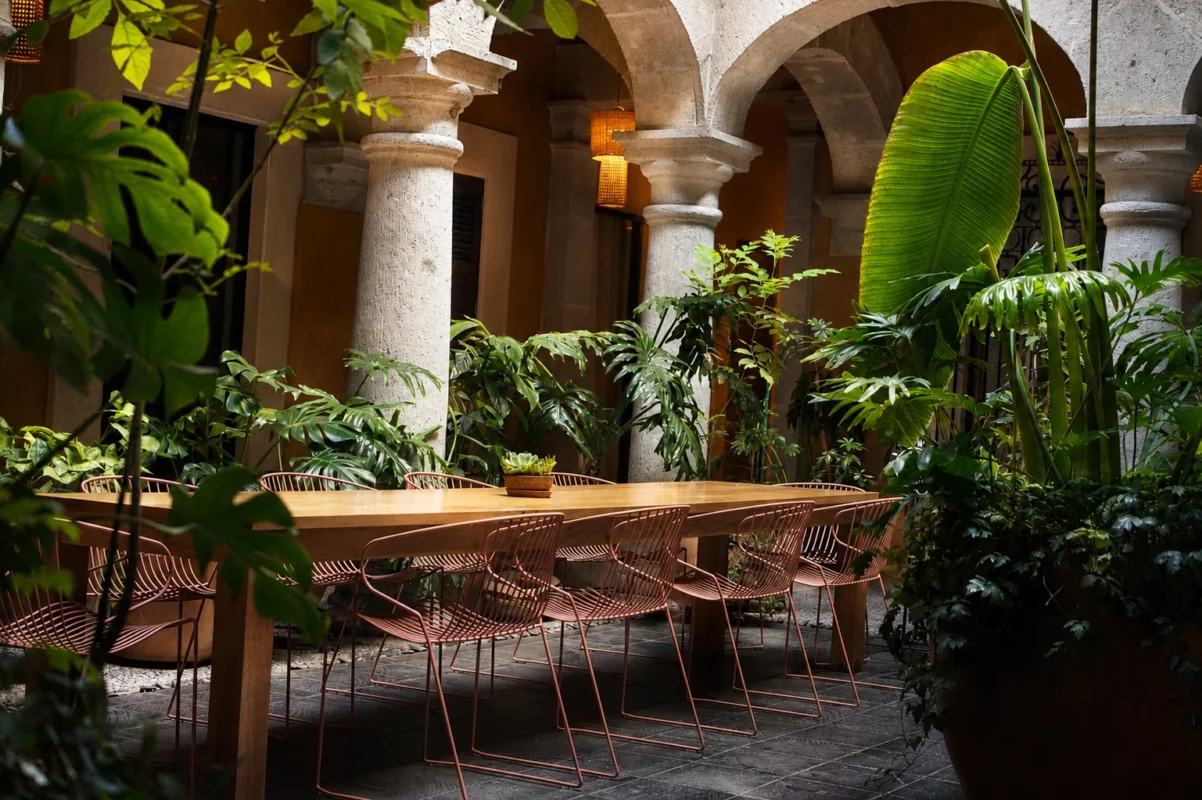
The towns along the valley corridor have little in the way of hotels, so a day trip into the Tlacolula Valley is best run from a base in Oaxaca City itself. For most visitors weighing the best area to stay in Oaxaca, that means the historic center: walkable, close to the second-class bus terminal where valley-bound colectivos depart, and within a few minutes of the Highway 190 routes that lead out to the valley. The three options below sit at different points on the price spectrum. Readers looking for a longer shortlist of the city’s boutique stays can find it in our guide to Oaxaca’s boutique hotels.
Casa Antonieta
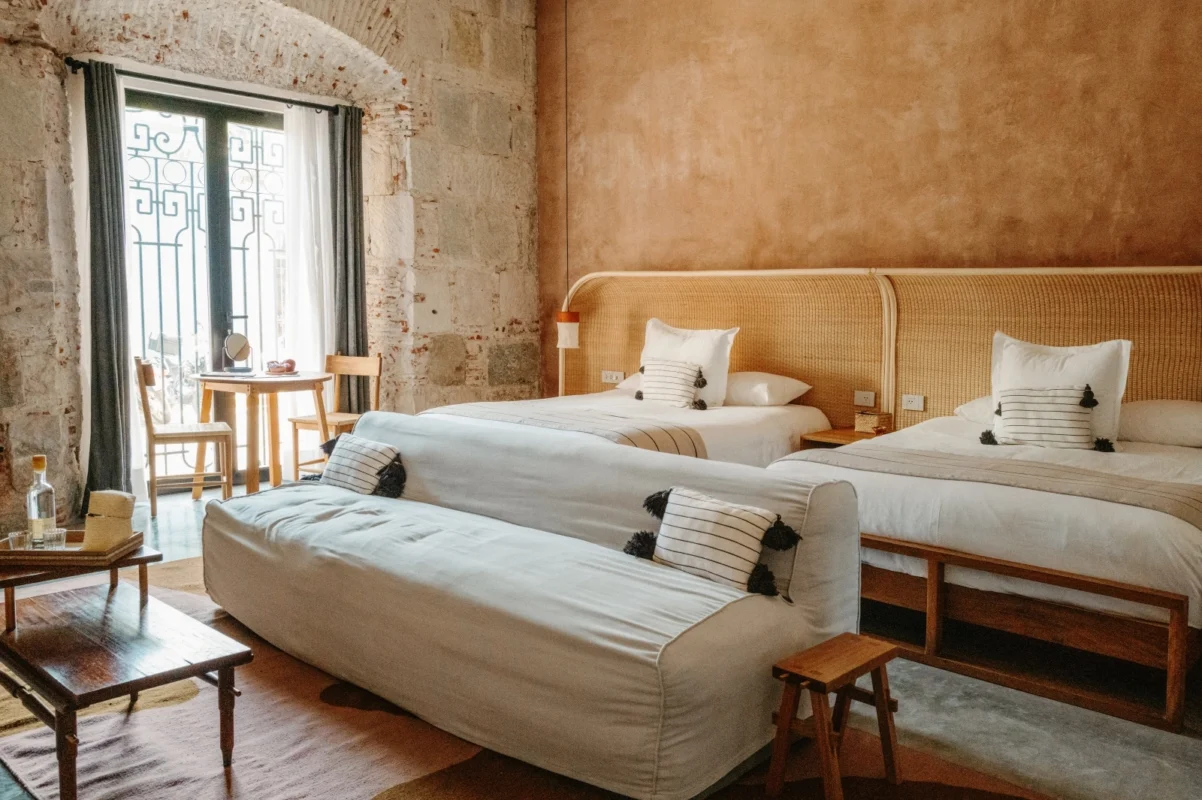
Set inside the original 1535 San Pablo convent complex, one of the oldest surviving structures in the city, Casa Antonieta arranges its rooms around a stone courtyard. Muss Cafe occupies the ground floor, and the rooftop restaurant Amá Terraza serves dinner above the roofline of the historic center. The earth-finish walls and quarry stone arches of the viceregal construction are left intact rather than polished over. Pricing sits in the middle of the city’s boutique range, below the newer design properties but above the guesthouses near the bus terminals.
Otro Oaxaca
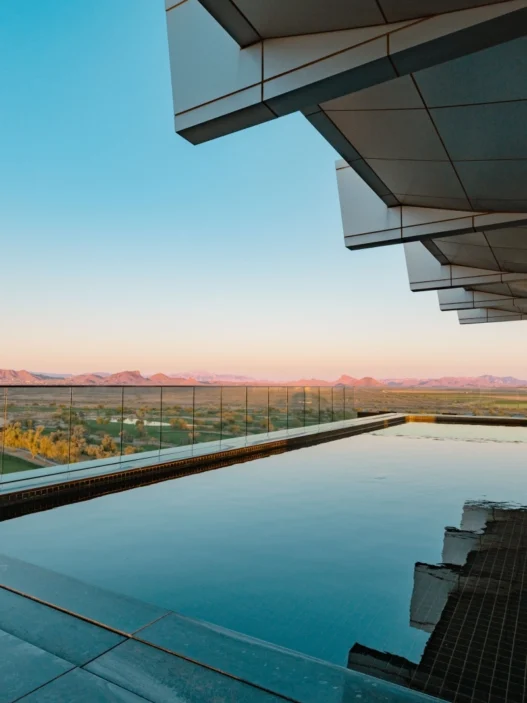
Across the street from the Templo de Santo Domingo, a 30-foot rooftop pool runs the length of the building’s top floor, with the church’s carved stone facade filling the view from the water, a rare amenity among boutique hotels packed into the historic center’s colonial-era buildings. Opened in 2023 and designed around the geometric stonework of Mitla, 45 kilometers east, the hotel reworks a colonial-era building with green limestone floors, brick vaulting, and an in-house mezcal bar. Part of the Design Hotels collection, it sits at the premium end of Oaxaca’s lodging market, with rooms considerably smaller than the views built around them.
AYOOK
On the quieter eastern edge of the historic center, AYOOK occupies the shell of an eighteenth-century house, its twelve rooms arranged around a garden courtyard. The name comes from the Mixe people’s own term for their language, a reference acknowledged in the property’s signage rather than its marketing. Rooms are simply furnished, air-conditioned, and finished with local textiles and tile. At under $100 a night in low season, it is one of the more accessible options in the centro, a nine-minute walk from the Zocalo and a short ride from the Highway 190 onramp.
Where to Eat
Tlamanalli, Teotitlan del Valle. Run by chef Abigail Mendoza and her sisters since 1990, Tlamanalli serves Zapotec dishes, mole, squash-blossom soup, made with techniques and recipes passed down through the family rather than adapted for a tourist menu. The restaurant drew attention from Gourmet magazine and the New York Times in the early 1990s, and the format hasn’t changed since: a short, fixed selection of dishes cooked to order in an open kitchen.
Tlacolula market, Sunday only. Beyond the barbacoa stalls, the market’s comedor section sells memelas, consomme, and other dishes meant to be eaten standing at a counter rather than carried out. Vendors set up early and sell out by mid-afternoon, so a market visit works best paired with a late breakfast rather than lunch.
Palenque meals, Santiago Matatlan. Several palenques pair a mezcal tasting with a simple meal, memelas or quesadillas cooked over the same wood fire used to roast agave, for visitors who arrange the stop in advance through a tour or local contact.
Practical Notes
Colectivos to Tlacolula, Mitla, and onward toward Matatlan leave from a stand near the second-class bus terminal in Oaxaca City and cost a few pesos per leg; they’re frequent but don’t run on a fixed schedule, so timing a return trip requires some flexibility. A rental car covers the same route on a schedule of the traveler’s choosing, and Highway 190 is paved and well signed the entire way. Organized tours, typically a half-day for Mitla and Matatlan or a full day adding Tlacolula on a Sunday, remove the logistics at the cost of a fixed itinerary.
At weaving workshops and palenques, asking before photographing looms, dye vats, or stills is standard courtesy, and most hosts are glad to explain the process to anyone who asks. Cash in pesos is necessary outside the city; few stops along the corridor take cards. Light bargaining is normal at the Tlacolula market and at workshop prices, but not at food stalls.
Is the Tlacolula Valley worth a full day trip from Oaxaca City?
For travelers with one extra day, yes, particularly if it falls on a Sunday and can combine the Tlacolula market with Mitla and a palenque stop in Matatlan. On other days, the valley still rewards a half-day trip built around Mitla and Teotitlan del Valle, with the market left for a future visit.
What’s the difference between Mitla and Monte Alban?
Monte Alban, the hilltop site west of the city, was the political and ceremonial capital of the Zapotec state for over a thousand years. Mitla, in the Tlacolula Valley to the east, served a different function: a burial ground and religious site for nobility and priests, known for its mosaic stonework rather than its plazas and ball courts. The two sites tell complementary parts of the same history rather than overlapping versions of it.
Can you visit the Tlacolula Valley’s mezcal towns without a car?
Yes, though it takes more planning. Colectivos run from Oaxaca City to Mitla and on toward Matatlan along Highway 190, and walking between palenques on the main road is possible in Matatlan itself. For a single day covering multiple palenques and a tasting that includes an explanation of the production process, an organized tour or a local driver is more efficient than relying on colectivos alone.
What’s the best area to stay in Oaxaca for a trip like this?
The historic center remains the best area to stay in Oaxaca for combining city sightseeing with a Tlacolula Valley day trip. Colectivos to Tlacolula, Mitla, and Matatlan leave from a stand near the second-class bus terminal on the city’s eastern edge, a short walk or taxi ride from most centro hotels, and Highway 190 is easiest to pick up from that side of town.
The four stops share a road but little else: a market that runs on a centuries-old weekly rhythm, a burial ground turned mosaic gallery, a weaving village that sells from the loom, and a town that distills its own name into spirit. None of it was arranged for a single day’s itinerary, which is, in the end, most of what makes treating it as one worth the early start.