





The porcelain cup – wide-lipped, handled like a small teapot – is available at every shop along Mlýnská kolonáda for less than the price of a coffee. Fill it at the Mill Spring tap, walk the length of the colonnaded promenade between sips, and repeat the circuit. This is the pitná kúra, the thermal spa tradition that has organized travel to Karlovy Vary, Czech Republic, since Holy Roman Emperor Charles IV developed the springs in the fourteenth century. The town’s twelve mineral springs – all drawing from the same underground geothermal source, the Vřídlo zone, and ranging in temperature from 30°C to 72°C – have been prescribed for digestive disorders, metabolic conditions, and locomotor complaints since the town’s formal chartering in 1370. The thermal spa hotel culture that grew up around them spans Habsburg-era grand hotels, modernist state sanatoria, and Art Nouveau villas now operating as accredited medical spas.
Karlovy Vary entered the transnational UNESCO World Heritage Site “Great Spa Towns of Europe” in 2021, alongside Bath, Vichy, and seven other cities, on the basis of its intact spa architecture and unbroken treatment tradition. What follows covers four properties representing different entry points to a stay here: the Grandhotel Pupp, the town’s founding luxury landmark since 1701; the Savoy Westend Hotel, five connected Art Nouveau villas accredited by the Czech Ministry of Health; Spa Hotel Thermal, the late-modernist concrete building that doubles as the main venue for the Karlovy Vary International Film Festival; and Spa Hotel Villa Ritter, a quieter eighteen-room option within walking distance of the colonnades. For context on where Karlovy Vary sits in the European tradition of volcanic and mineral spring destinations, the SanctumStay guide to Tuscany’s thermal spa towns covers the Italian side of the same geological story.
At a glance: 
- Best season: May through September, when the colonnades are most animated and the outdoor thermal pools operate at full capacity; July brings the KVIFF film festival, which fills every hotel in the city and requires booking months in advance.
- How to arrive: FlixBus or RegioJet from Prague’s Florenc station reaches Karlovy Vary in approximately two hours; the train from Praha Hlavní nádraží takes around three and a half hours. Prague Airport (PRG) is the main international gateway – take the aeroexpress to the main station, then connect. Karlovy Vary Airport (KLV) handles limited seasonal routes.
- How long to stay: Three nights covers the colonnades, the Becherovka museum, and a treatment or two at a proper pace; a full therapeutic stay with daily balneological procedures runs most effectively over a week.
- Who it’s for: Travelers who prefer European spa architecture and a medically grounded treatment tradition over retreat-format wellness; anyone interested in the drinking cure as cultural practice.
- Don’t expect: A lively independent dining scene or nightlife; the spa zone is quiet by European city standards, and most visitors eat at their hotel or choose from a short list of established restaurants along Stará Louka.
- Where to Stay: Grandhotel Pupp for the landmark ultra-luxury spa experience at the south end of the colonnade promenade, Savoy Westend Hotel for the most medically comprehensive program in town, Spa Hotel Thermal for the outdoor thermal pool and mid-range therapeutic stays, and Spa Hotel Villa Ritter at the most accessible price point with central location.
Why Karlovy Vary
The name translates as “Charles’s Bath” – named for the Bohemian King and Holy Roman Emperor Charles IV, who developed the springs around 1358 and chartered the town twelve years later. By the 18th and 19th centuries, Karlovy Vary (known then by its German name Karlsbad) had become the most fashionable spa destination in continental Europe. Goethe visited thirteen times. Beethoven, Peter the Great, Chopin, Brahms, and Franz Kafka all came for the cure. The Austrian and Bohemian aristocracy regarded a Karlsbad season as part of the annual calendar. What drew them was not the bathing – Karlovy Vary’s tradition centers on drinking the mineral water, not immersing in it, which distinguishes it from the bathing cultures of Iceland’s geothermal pools or the volcanic island spas of the Mediterranean. The springs’ alkaline, bicarbonate-rich chemistry was prescribed specifically for digestive disorders, liver conditions, gout, and metabolic complaints, making the Karlsbader Kur a medical protocol rather than a leisure practice.
The water chemistry also accounts for Becherovka, the herbal bitters Jan Becher compounded in 1807 and nicknamed the “thirteenth spring” of Karlovy Vary. The recipe drew on the same spa tradition’s relationship with digestion and the local pharmacopoeia of botanical bitters; it remains in production at the original factory site in the city center. Karlovy Vary’s UNESCO inscription recognizes the architectural record of successive investment in the spa’s infrastructure – Baroque, Empire, Art Nouveau, and Functionalist layers accumulated over four centuries and still largely intact – as well as the continuity of the cure itself.
The Land
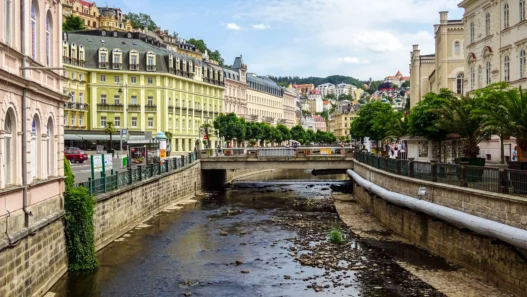
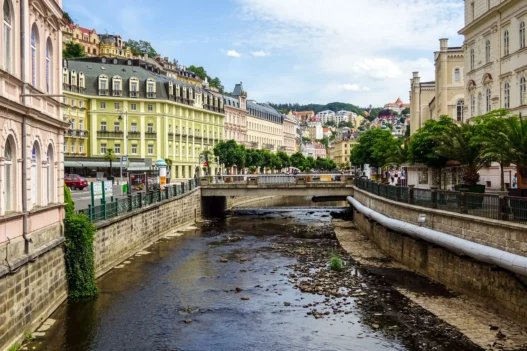
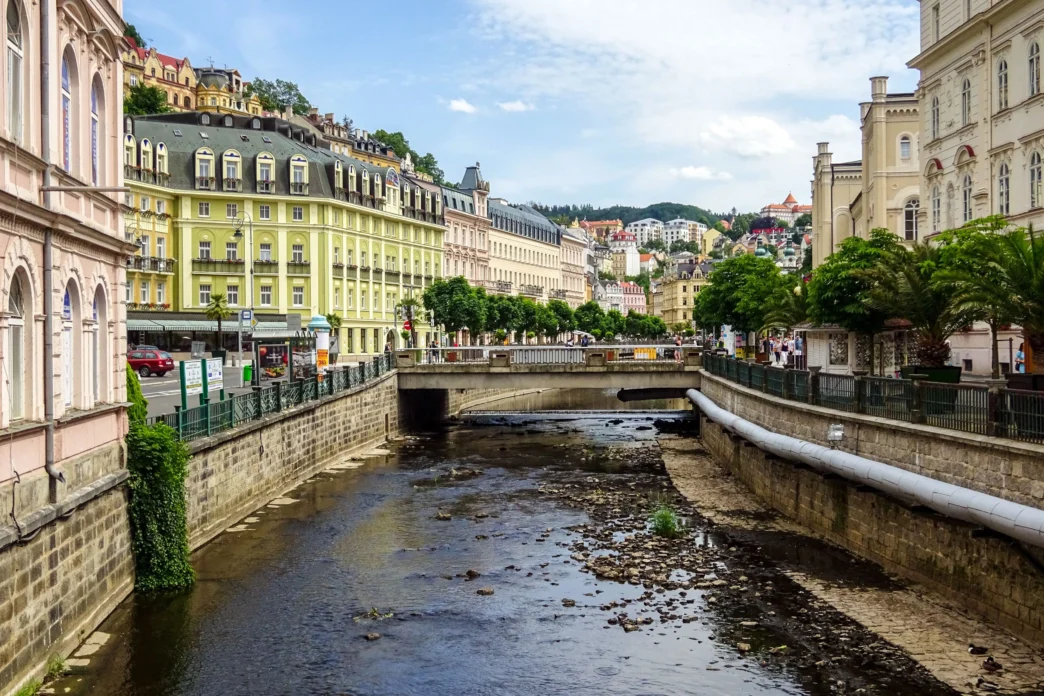
The spa zone occupies the narrow valley of the Teplá river, a tributary of the Ohře, where the original springs emerge along the hillside. The five colonnades and most of the grand spa hotels line the western bank of the Teplá, on the pedestrian promenade called Stará Louka (Old Meadow). The Ohře river, into which the Teplá flows at the northern end of the promenade, marks the edge of the older commercial center. From the main railway station at the northern edge of the city, the spa zone is about one kilometer on foot or a short tram ride south.
Hotel zones spread uphill from the valley floor. The Westend district (Lázeňská čtvrť) climbs the wooded hillside west of the promenade, where the Art Nouveau spa hotels sit behind tree canopy above Stará Louka. Spa Hotel Thermal occupies a different position entirely – above the northern end of the valley on the hill overlooking the Ohře confluence, its concrete massing visible from most of the spa zone below. The Diana Lookout Tower, accessible by funicular from Mariánská street, gives a full panoramic view of the valley layout, and the surrounding hillside forest – a 19th-century landscape park laid out for visiting cure-takers who walked between colonnade sessions – remains walkable from the spa zone.
What to Do
The Drinking Cure at the Mill Colonnade. The Neo-Renaissance arcade completed in 1881 to a design by Josef Zítek – the architect responsible for the Prague National Theatre – houses five springs inside 124 sandstone columns. The Mill Spring (Mlýnský pramen), first recommended for drinking cures in 1705, anchors the south end; the Rock, Libuše, Rusalka, and Prince Wenceslas springs extend north. The ritual requires a long-spouted porcelain cup (sold at shops along the promenade), filled at the spring tap and sipped while walking the colonnade, progressing from cooler to hotter sources. Spa physicians have traditionally prescribed 700 to 1,000 milliliters daily, taken before meals. No booking required; the taps flow continuously.
The Vřídlo Geyser at the Hot Spring Colonnade. The most powerful spring in Karlovy Vary surfaces at 72°C and reaches 12 meters in height, visible through the glass walls of the 1975 Functionalist pavilion that encloses it. Five cooling taps around the main pool distribute the water at 30°C and 50°C for the drinking cure. The spring produces approximately 2,000 liters per minute, supplying nearly all the thermal water to the hotels along the promenade. Below street level, the underground spring gallery allows direct observation of the geological source.
Jan Becher Museum. The original Becherovka distillery on T.G. Masaryka street holds a museum tracing the production history of the herbal bitters since 1807. The recipe remains officially secret (known to two people at any given time), but the museum documents the botanical ingredients and distillation process in enough detail to establish the drink’s historical relationship with the spa cure. Tours include tastings of Becherovka and the newer Lemond variant.
Diana Lookout Tower. A funicular from Mariánská street, at the western edge of the spa zone, climbs to the Diana tower at the crest of the forested hillside. From the top, the Teplá valley and the full sequence of colonnades are visible in a single view. The surrounding forest park, established in the 19th century for the cure-takers who walked between colonnade visits, connects to a network of trails above the town. The funicular runs year-round.
Spa Wafers (Oplatky). Thin waffle-textured discs filled with chocolate, hazelnut, or vanilla have been produced in Karlovy Vary since the 18th century, originally dispensed by spa physicians alongside the mineral water as a caloric supplement that wouldn’t disrupt treatment protocols. Multiple bakeries on Jan Kupecký street and along the promenade produce them fresh daily. The quality difference between fresh-baked and packaged-souvenir versions is substantial enough to merit the short walk to a producing shop.
Where to Stay
Grandhotel Pupp
The building anchoring the south end of Stará Louka traces its origins to 1701, when the Saxon Hall was constructed on this site. Johann Georg Pupp, a confectioner who arrived in Karlovy Vary in 1760, eventually took full ownership and gave the property the family name it has carried for two and a half centuries. The hotel’s Grand Wing, in its current Baroque-Classicist form, reads from the hillside above as the compositional anchor of the valley – white facade, mansard roofline, the widest footprint of any building in the spa zone. Goethe, Beethoven, and Chopin all stayed here during the Karlsbad season.
The Pupp Royal Spa occupies the hotel’s lower floors, with a thermal pool, whirlpool, sauna and steam areas, fitness center, and the Pupp Royal Clinic incorporating a cardio spa team and aesthetic medicine consultations. The treatment roster covers classical Karlovy Vary procedures – mineral baths, perlicka pearl baths, peat wraps – alongside massage and Ayurvedic treatments. Grandrestaurant Pupp and the smaller Malá Dvorana, noted in the Michelin Guide, handle the hotel’s formal dining. Ultra-luxury by European spa hotel standards.
Book at Grandhotel PuppSavoy Westend Hotel
Five Art Nouveau villas built between 1897 and the early 1900s, connected by a shared interior, comprise the Savoy Westend. The Westend district climbs the hillside above the promenade, and the villas’ Belle Époque ornament – curved bay windows, carved balustrades, painted facadesin ochre and cream – forms part of the hillside architectural layering visible from the valley. The Savoy Westend holds accreditation from the Czech Ministry of Health, the only hotel in Karlovy Vary to have received it, and operates a medical spa center with over 300 diagnostic and therapeutic procedures.
The treatment program covers the full classical Karlovy Vary protocol: hydrotherapy, thermotherapy, electrotherapy, the drinking cure, physical therapy, and nutritional counseling, alongside a salt cave and aesthetic medicine. Medical staff conduct an intake examination at the start of each therapeutic stay, producing an individual procedure plan for the duration of the visit. Premium pricing, with the medical depth justifying the investment for anyone traveling specifically for a treatment program rather than a general spa stay.
Book at Savoy WestendSpa Hotel Thermal
The concrete building completed in 1977 and rising above the northern end of the spa zone was a statement of Brutalist confidence in the Vřídlo’s thermal water as the organizing principle of the whole hilltop site. Spa Hotel Thermal serves as the main venue for the Karlovy Vary International Film Festival each July – one of Central Europe’s largest film festivals and a Category A event alongside Cannes and Berlin. Its rooftop outdoor thermal pool, fed directly by Vřídlo spring water and maintained at 38°C year-round under the brand name Saunia, commands views across the valley that justify the walk up from the promenade.
The balneological center occupies two underground floors, with mineral baths, aquatic gymnastics, electrotherapy, a salt cave, and hydrotherapy using 100% spring water. The therapeutic stay program begins at around 18 procedures per week following an initial medical consultation, with package options from five days to three weeks. Mid-range by Karlovy Vary spa hotel standards, making it the most accessible property on this list for a therapeutically complete stay that includes daily procedures, pool access, and medical consultation.
Book at Spa Hotel ThermalSpa Hotel Villa Ritter
Eighteen rooms in a 4-star property on Krále Jiřího street, seven minutes’ walk from the Mill Colonnade, make Villa Ritter the quietest option among Karlovy Vary’s centrally located spa hotels. The BALNEO spa on the lower floor offers over 25 types of balneological procedures, including reflexology and the standard mineral and therapeutic treatment range. An indoor pool, sauna, and steam room complete the facilities. The property’s size means treatments book faster than at the larger hotels; advance reservation for procedures matters, particularly in summer. One of the more accessible price points among spa hotels within easy walking distance of the colonnades.
Book at Spa Hotel Villa RitterWhere to Eat
Malá Dvorana. The smaller of Grandhotel Pupp’s two main dining venues occupies a side hall of the Grand Wing, with elaborate plasterwork and a crystal chandelier above a contemporary European menu – pan-fried fish, contemporary meat preparations, seasonal desserts from the hotel’s pastry kitchen. The Michelin Guide notes it for the combination of formal setting and contemporary execution. Reservation required, particularly in summer and during KVIFF.
Sklipek. A step below the Stará Louka promenade, Sklipek serves Bohemian cooking at prices the spa-zone hotels don’t match: svíčková (marinated sirloin with cream sauce and bread dumplings), pork with braised cabbage, roast duck in the Czech tradition. The menu covers the Bohemian canon without spa-town pricing. Lunch is the most practical sitting.
Café Pupp. For afternoon oplatky with coffee, the Café Pupp terrace overlooks Stará Louka promenade below – cakes from the hotel pastry kitchen, the particular quality of afternoon light at the south end of the valley in summer, and a view of whoever is still walking the colonnade circuit. No reservation necessary for the café.
Practical Notes
By bus from Prague’s Florenc station: approximately two hours, with multiple daily departures; FlixBus and RegioJet both serve the route. By train from Praha Hlavní nádraží: approximately three and a half hours through the Bohemian hills. By car via the D6 motorway: approximately one and a half hours from central Prague. Travelers arriving at Prague Airport (PRG) can reach Karlovy Vary by private transfer in about ninety minutes. Karlovy Vary’s own airport (KLV) handles limited seasonal and charter routes.
The KVIFF film festival occupies the first full week of July; hotel rates increase significantly and booking six months ahead is realistic for that period. Outside KVIFF, the primary season runs May through September. Spa services operate year-round, and December through February is the quietest period with the lowest rates. Thermal pools require standard swimwear; spa hotels provide robes and slippers for balneological treatments. Advance booking of specific procedures is strongly recommended at all four properties, particularly in summer.
How many days do you need in Karlovy Vary?
Three nights covers the colonnades at an unhurried pace, the Becherovka museum, the Diana funicular, and one or two spa treatments. A therapeutic stay with daily balneological procedures and a medical intake consultation – the format Hotel Thermal and Savoy Westend are built for – runs most effectively over a week. Day trips from Prague are common but allow only the colonnade circuit and one meal, leaving no time for treatments to accumulate any effect.
Is Karlovy Vary worth visiting without a spa treatment?
Yes. The colonnades, the 18th and 19th-century architecture, the drinking cure itself (the porcelain cup costs a few euros and spring water is free at all the taps), the Becherovka museum, and the hillside walking routes above the valley make a visit worthwhile without booking any treatment. The pitná kúra – filling the cup and walking between springs – is the core activity of Karlovy Vary’s spa culture, and it’s available to any visitor. The thermal spa hotels along the promenade also open their spa facilities for day-use bookings.
What is the best way to get from Prague to Karlovy Vary?
The bus is faster (about two hours from Florenc station) and more frequent than the train (three and a half hours). FlixBus and RegioJet run the route at low cost, with multiple daily departures. The train is more comfortable for longer stays with luggage, and the route passes through the Bohemian hills. By car from central Prague via the D6 motorway runs about one and a half hours, with paid parking in the spa zone center and free parking on the city perimeter with tram connections inward.
Late afternoon in the colonnade valley: the sandstone columns of the Mill Colonnade hold the lowering light, and the five spring taps continue their steady flow into the porcelain cups of whoever is still walking the prescribed circuit. The cure has been administered on this ground in some form since 1358. The architectural accumulation around it records the centuries of travelers who came for it. The water’s composition has not changed.


