



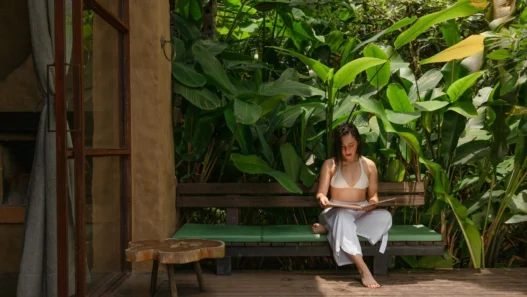


For many Western travelers, Indian ashrams evoke a single image: Rishikesh, the Ganga, a yoga mat, a white kurta. That image is not wrong, but it is partial. India’s ashram tradition spans lineages as formally distinct as the Satyananda system developed in Bihar and the Integral Yoga of Sri Aurobindo’s Pondicherry community; landscapes as different as the humid Tamil Nadu foothills and the 180 acres of parkland outside the Maharashtra hill station of Lonavla. The five below were chosen because each occupies a different position in both of those spectrums. Rishikesh appears once, not five times, because the other four traditions are worth the journey to reach them.
What they share: all five are currently operating, all have functioning official websites through which to verify programs and make contact, and all have operated long enough to have developed a coherent pedagogical identity rather than a rotating menu of retreat formats. For readers approaching this as a wellness rather than a spiritual inquiry, the SanctumStay roundup of best wellness retreats in the US covers program-based options closer to home. For those committed to the subcontinent, the five below represent the range.
The shortlist: 
- Best for the Ganga Aarti ritual at dusk on the riverfront in Rishikesh: Parmarth Niketan
- Best for a four-month residential immersion in the Satyananda yoga lineage: Bihar School of Yoga, Munger
- Best for the Shambhavi Mahamudra practice at Sadhguru’s Tamil Nadu campus: Isha Yoga Center, Coimbatore
- Best for Integral Yoga in a living 2,000-person community in Pondicherry: Sri Aurobindo Ashram
- Best for yoga and Ayurveda at the world’s oldest scientific yoga research institute: Kaivalyadhama, Lonavla

Parmarth Niketan, Rishikesh
The Ganga Aarti at Parmarth Niketan begins at sunset without announcement – oil lamps lit on the riverfront, bhajans rising from the ghats, the river receiving the light as it has received it here since the ashram’s founding in 1942. Parmarth Niketan is the largest ashram in Rishikesh, with accommodation for thousands of guests from across the world on its campus on the banks of the Ganga in Swarg Ashram, the quieter bank away from Rishikesh’s commercial center. The founding lineage traces to Pujya Swami Shukdevanandji Maharaj; the ashram is currently led by Swami Chidanand Saraswatiji.
Daily programming covers morning yoga, pranayama, meditation, satsang, and the evening Aarti, which functions as the ashram’s communal anchor regardless of the guest’s level of practice or prior familiarity with the tradition. The International Yoga Festival, held annually in March, draws teachers from across the world’s yoga lineages for eight days of intensive practice and instruction – one of the few events where Iyengar, Ashtanga, Kundalini, and Vedanta teachers share a single schedule. Accommodation is available directly through the ashram; rates are donation-based or nominal, placing Parmarth at the accessible end of any ashram india comparison. The ashram is open to all, without restriction on nationality, religion, or prior practice experience.
Bihar School of Yoga, Munger
The Bihar School of Yoga occupies Ganga Darshan – a fort-positioned campus above the river at Munger, in Bihar state, roughly 170 kilometers east of Patna. The view from the campus takes in the Ganga below and the agricultural plain beyond; the setting is austere in the way that serious residential practice tends to require. Founded in 1964 by Swami Satyananda Saraswati, a direct disciple of Swami Sivananda, the school developed the Satyananda yoga system – a synthesis of hatha, raja, karma, and bhakti yoga that became one of the most formally documented yoga lineages of the 20th century, with its own extensive text library still in print.
The primary residential program is the four-month Course in Yogic Studies – a sequential, systematic immersion designed to build practice from the ground up rather than sample formats across a week. It is not a beginner retreat in the casual sense: the structure is monastic, the schedule is demanding, and the expectation is that participants arrive with some prior commitment to practice. Shorter programs and annual festivals also run through the year. Accommodation, meals, and instruction are all-inclusive within the residential format; costs are kept minimal relative to international retreat pricing, reflecting the ashram’s non-commercial ethos. Contact and program details are available directly through biharyoga.net.
Isha Yoga Center, Coimbatore
The Dhyanalinga – a consecrated meditative space at the Isha Yoga Center – is open to visitors without any requirement of initiation or belief, and the geometry of the dome and the quality of the silence inside it register differently than most meditation rooms because they were designed for a specific experiential function rather than for architectural effect. The Isha Yoga Center sits in the Velliangiri foothills outside Coimbatore in Tamil Nadu, on a campus developed by Sadhguru (Jaggi Vasudev) and the Isha Foundation from the early 1990s onward. The scale is significant – the center accommodates thousands during major programs – but the core offerings are precisely structured.
The signature practice offered at the center is Shambhavi Mahamudra, a 21-minute kriya transmitted through the Inner Engineering program – a seven-session course available online or in person, prerequisite to the residential immersions at the center. The Bhava Spandana program is a four-day, three-night residential experience for those already initiated into Shambhavi, designed to deepen the practice in an intensive group setting. Accommodation and meals are available on campus for program participants; costs vary by program and are published on the official Isha Yoga website. The center also hosts Mahashivratri annually, a night-long meditation event that draws hundreds of thousands of visitors to the campus.
Sri Aurobindo Ashram, Pondicherry
The samadhi of Sri Aurobindo and The Mother occupies the central courtyard of the ashram in Pondicherry – a white marble slab under a flowering frangipani, with visitors sitting in silence around it at most hours of the day. Sri Aurobindo Ashram was founded in 1926 by Sri Aurobindo, who had arrived in Pondicherry in 1910 after leaving active political life in Bengal, and Mirra Alfassa (The Mother), a French spiritual practitioner who became the ashram’s organizational center after Sri Aurobindo’s passing in 1950. The philosophy of Integral Yoga – Aurobindo’s synthesis of Vedantic philosophy with an evolutionary spiritual framework – is the ashram’s animating principle rather than a format of classes or practices.
The ashram today is a living community of roughly 2,000 residents engaged in work as a form of practice – printing, handicrafts, education, agriculture, and various departments that have operated continuously for decades. Visitors can enter the main ashram building during published hours and stay at the ashram’s guest houses, including the Park Guest House, managed by the ashram and intended for those coming to visit rather than tour. Accommodation is modest, availability is limited, and contact is made directly with the guest houses rather than through a booking platform. The adjacent township of Auroville, founded in 1968 by The Mother on the same philosophical lineage, offers additional visitor accommodation and a different expression of the same project.
Kaivalyadhama, Lonavla
The research laboratory at Kaivalyadhama has been measuring physiological responses to pranayama and asana since 1924 – the year Swami Kuvalayananda founded the institute at Lonavla, in the Sahyadri mountains of Maharashtra, with the specific intention of subjecting yoga practice to scientific scrutiny rather than accepting it on traditional authority alone. That founding decision makes Kaivalyadhama the oldest yoga research institute in the world and gives its programs a character unlike those of any devotional or lineage-based ashram: the approach here is investigative, the documentation extensive, and the yoga taught as a system with understood physiological mechanisms rather than a received spiritual technology.
The campus covers 180 acres of parkland, with accommodation, dining, a health center offering Ayurvedic and naturopathic therapies, and a yoga college running short courses and teacher training. The Yoga and Ayurveda-Panchakarma program – one week, combining detoxification therapies with daily yoga and meditation – is the most accessible entry point for visitors coming for a defined stay. Vegetarian food is provided throughout; accommodation is on campus. Pricing is available directly through kdham.com and sits at the mid-range end of the Indian retreat market. Lonavla is easily reached from both Mumbai (two hours) and Pune (one hour).
Do I need prior yoga experience to stay at an ashram in India?
It depends on the ashram. Parmarth Niketan and Sri Aurobindo Ashram are open to complete beginners with no prior practice requirement. Isha Yoga Center requires completion of the Inner Engineering program before attending residential programs. Bihar School of Yoga’s four-month course expects serious commitment and some prior exposure to yoga, though shorter programs are more accessible. Kaivalyadhama’s week-long Yoga and Ayurveda program is suitable for beginners. Contact each ashram directly to confirm current prerequisites before booking travel.
How much does it cost to stay at an ashram in India?
Costs range from near-zero to mid-range by international standards. Parmarth Niketan in Rishikesh operates on donation-based or minimal accommodation rates. Bihar School of Yoga keeps costs low relative to its residential program length. Sri Aurobindo Ashram’s guest houses charge modest rates. Isha Yoga Center’s program fees vary by type and duration – published on ishayoga.org. Kaivalyadhama’s week-long programs are priced at the mid-range of the Indian retreat market. None of the five operate at luxury pricing; the ashram india model generally keeps costs below equivalent retreat programs in Europe or North America.
What is the best time of year to visit ashrams in India?
October through March is the most comfortable period across most of India. Rishikesh is best visited October through April – the International Yoga Festival runs in early March. Pondicherry and Coimbatore have more consistent year-round climates, with the October-November northeast monsoon bringing heavier rain to Tamil Nadu. Bihar and Maharashtra are most comfortable from November through February. Summer months (April through June) are intense in Rishikesh and Bihar; the monsoon (July through September) affects most of the country, though ashram programming typically continues regardless of season.
The five ashrams above have been operating for between 62 and 102 years. That longevity is the most reliable signal available in a market where retreat centers open and close with some frequency. The practices taught at each have been refined across decades of residential experience rather than assembled from current wellness trends – which is either reassuring or beside the point, depending on what the visitor is actually looking for when they type ashram india into a search bar.